Motorhomes, Caravans & Destinations Magazine feature
The Healing Power of Food
Staying active and making the most of every day starts with looking after your health, and that becomes even more important when your body is recovering from illness or surgery.
While rest and rehabilitation are often front of mind, nutrition is another powerful tool that can help support healing and recovery, yet this is often underestimated, even when our bodies need extra support.
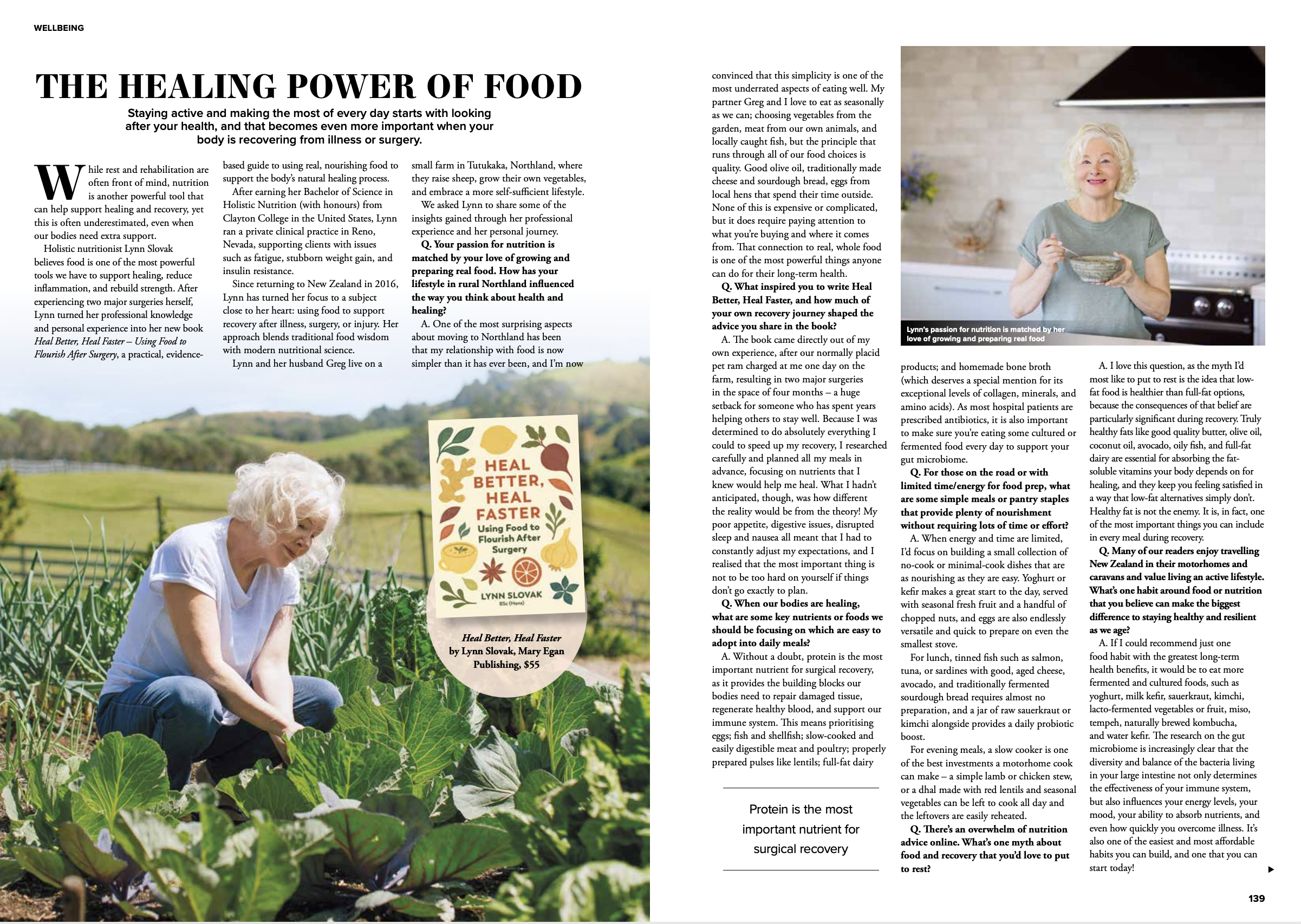
Holistic nutritionist Lynn Slovak believes food is one of the most powerful tools we have to support healing, reduce inflammation, and rebuild strength. After experiencing two major surgeries herself, Lynn turned her professional knowledge and personal experience into her new book Heal Better, Heal Faster – Using Food to Flourish After Surgery, a practical, evidence-based guide to using real, nourishing food to support the body’s natural healing process.
After earning her Bachelor of Science in Holistic Nutrition (with honours) from Clayton College in the United States, Lynn ran a private clinical practice in Reno, Nevada, supporting clients with issues such as fatigue, stubborn weight gain, and insulin resistance.
Since returning to New Zealand in 2016, Lynn has turned her focus to a subject close to her heart: using food to support recovery after illness, surgery, or injury. Her approach blends traditional food wisdom with modern nutritional science.
Lynn and her husband Greg live on a small farm in Tutukaka, Northland, where they raise sheep, grow their own vegetables, and embrace a more self-sufficient lifestyle.
We asked Lynn to share some of the insights gained through her professional experience and her personal journey.
Your passion for nutrition is matched by your love of growing and preparing real food. How has your lifestyle in rural Northland influenced the way you think about health and healing?
One of the most surprising aspects about moving to Northland has been that my relationship with food is now simpler than it has ever been, and I’m now convinced that this simplicity is one of the most underrated aspects of eating well.
My partner Greg and I love to eat as seasonally as we can, choosing vegetables from the garden, meat from our own animals, and locally caught fish, but the principle that runs through all of our food choices is quality. Good olive oil, traditionally made cheese and sourdough bread, eggs from local hens that spend their time outside.
None of this is expensive or complicated, but it does require paying attention to what you’re buying and where it comes from. That connection to real, whole food is one of the most powerful things anyone can do for their long-term health.
What inspired you to write Heal Better, Heal Faster, and how much of your own recovery journey shaped the advice you share in the book?
The book came directly out of my own experience, after our normally placid pet ram charged at me one day on the farm, resulting in two major surgeries in the space of four months – a huge setback for someone who has spent years helping others to stay well.
Because I was determined to do absolutely everything I could to speed up my recovery, I researched carefully and planned all my meals in advance, focusing on nutrients that I knew would help me heal. What I hadn’t anticipated, though, was how different the reality would be from the theory!
My poor appetite, digestive issues, disrupted sleep and nausea all meant that I had to constantly adjust my expectations, and I realised that the most important thing is not to be too hard on yourself if things don’t go exactly to plan.
When our bodies are healing, what are some key nutrients or foods we should be focusing on which are easy to adopt into daily meals?
Without a doubt, protein is the most important nutrient for surgical recovery, as it provides the building blocks our bodies need to repair damaged tissue, regenerate healthy blood, and support our immune system.
This means prioritising eggs; fish and shellfish; slow-cooked and easily digestible meat and poultry; properly prepared pulses like lentils; full-fat dairy products; and homemade bone broth, which deserves a special mention for its exceptional levels of collagen, minerals, and amino acids.
As most hospital patients are prescribed antibiotics, it is also important to make sure you’re eating some cultured or fermented food every day to support your gut microbiome.
For those on the road or with limited time or energy for food preparation, what are some simple meals or pantry staples that provide plenty of nourishment without requiring lots of time or effort?
When energy and time are limited, I’d focus on building a small collection of no-cook or minimal-cook dishes that are as nourishing as they are easy.
Yoghurt or kefir makes a great start to the day, served with seasonal fresh fruit and a handful of chopped nuts, and eggs are also endlessly versatile and quick to prepare on even the smallest stove.
For lunch, tinned fish such as salmon, tuna, or sardines with good, aged cheese, avocado, and traditionally fermented sourdough bread requires almost no preparation, and a jar of raw sauerkraut or kimchi alongside provides a daily probiotic boost.
For evening meals, a slow cooker is one of the best investments a motorhome cook can make – a simple lamb or chicken stew, or a dhal made with red lentils and seasonal vegetables can be left to cook all day and the leftovers are easily reheated.
There’s an overwhelm of nutrition advice online. What’s one myth about food and recovery that you’d love to put to rest?
I love this question, as the myth I’d most like to put to rest is the idea that low-fat food is healthier than full-fat options, because the consequences of that belief are particularly significant during recovery.
Truly healthy fats like good-quality butter, olive oil, coconut oil, avocado, oily fish, and full-fat dairy are essential for absorbing the fat-soluble vitamins your body depends on for healing, and they keep you feeling satisfied in a way that low-fat alternatives simply don’t.
Healthy fat is not the enemy. It is, in fact, one of the most important things you can include in every meal during recovery.
Many of our readers enjoy travelling New Zealand in their motorhomes and caravans and value living an active lifestyle. What’s one habit around food or nutrition that you believe can make the biggest difference to staying healthy and resilient as we age?
If I could recommend just one food habit with the greatest long-term health benefits, it would be to eat more fermented and cultured foods, such as yoghurt, milk kefir, sauerkraut, kimchi, lacto-fermented vegetables or fruit, miso, tempeh, naturally brewed kombucha, and water kefir.
The research on the gut microbiome is increasingly clear that the diversity and balance of the bacteria living in your large intestine not only determines the effectiveness of your immune system, but also influences your energy levels, your mood, your ability to absorb nutrients, and even how quickly you overcome illness.
It’s also one of the easiest and most affordable habits you can build, and one that you can start today!
Recovery Recipes
Lynn’s book Heal Better, Heal Faster is absolutely packed with information, allowing you to dip into it repeatedly at your leisure. With chapters dedicated to the lymphatic system and the immune system, as well as a deep dive into preparing for and recovering from surgery, threaded throughout is vital food and ingredient knowledge, and of course deliciously nourishing recipes such as the two recipe extracts below.
Almond Date Muffins
These are so good that it’s hard to believe that they’re healthy, but each one is moist, delicious, and contains just over one teaspoon of honey. They’re also made with a combination of nut flour and besan, or chickpea flour, instead of gluten-free flour, which increases both their protein content and their fibre.
Try using chopped dried apricots or fresh raspberries instead of the dates, adding a little grated orange zest, or substituting ground hazelnuts for the almond flour. You could even make a savoury muffin using grated cheese, chopped sun-dried tomatoes and fresh herbs.
Ingredients
2 cups almond flour
½ cup besan, sifted
1½ teaspoons baking powder
¾ cup chopped dates
Pinch of sea salt
¼ cup honey
60g butter, or 4 tablespoons coconut oil
2 eggs
¼ cup kefir or yoghurt
½ teaspoon baking soda
Method
Preheat the oven to 180°C. Line a 10-hole muffin pan with paper cases.
Add the almond flour, sifted besan, baking powder, and sea salt to a mixing bowl. Fold in the dates.
Gently heat the honey and butter or coconut oil until melted and stir in the baking soda.
When frothy, pour the mixture over the dried ingredients, fold in the eggs and kefir or yoghurt, and divide evenly between the paper cases. Bake for 20–22 minutes.
Parsley and Leek Soup
Ingredients
2 large bunches of organic parsley, washed and roughly chopped; stalks are fine
A large pat of butter
1 leek, white part only, thinly sliced; save the green part in the freezer for broth
4 cups homemade chicken broth
1 teaspoon salt and a good grind of black pepper
1 tablespoon freshly squeezed lemon juice
2 tablespoons cream
Method
Blanch half of the parsley in boiling water for 30 seconds, drain and refresh under cold water to retain the bright green colour.
Melt the butter in a large saucepan over low-medium heat, and very gently cook the leek for 10 minutes until nicely softened and golden. Try not to let it colour too much or the final colour of the soup will not be as green.
Add the chicken broth, the uncooked parsley, the salt and some freshly ground black pepper to the saucepan, and simmer partially covered for 30 minutes.
Remove the pan from the heat, add the blanched parsley, the lemon juice and the cream, and blend with a stick blender until smooth.